Axial loading is not simply a matter of selecting a bearing with a higher load rating. In precision machinery, the bearing must also control elastic deformation, maintain contact stability, and preserve positioning accuracy throughout repeated operating cycles.
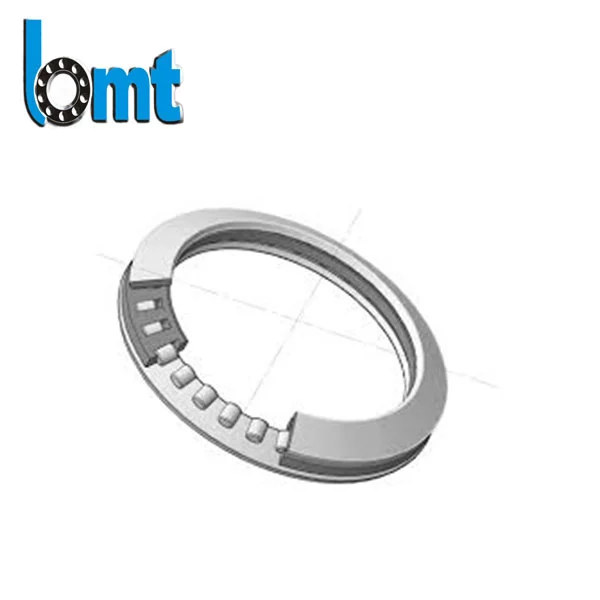
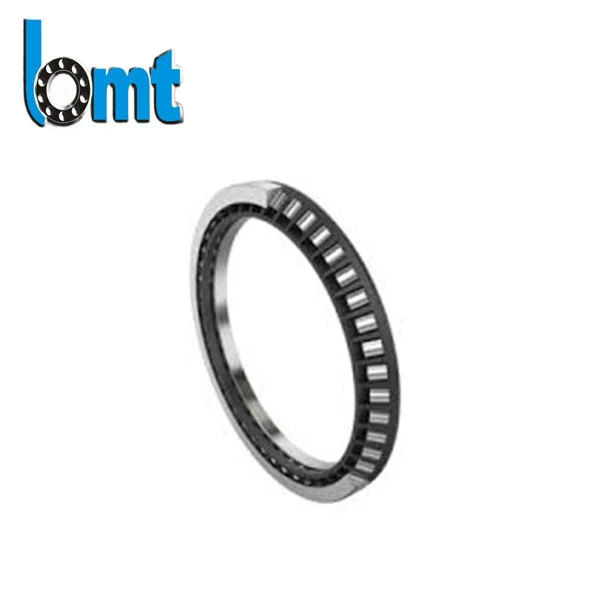
The SGL Series uses an angular contact roller arrangement to provide controlled contact between the rolling elements and raceways. This makes it suitable for applications where axial rigidity and positioning behavior are more important than the requirements of a conventional thrust bearing.
For equipment manufacturers, bearing selection should therefore consider the complete operating condition rather than bearing dimensions alone. Axial and radial loads, preload, rotational speed, temperature, lubrication, shaft and housing accuracy, and installation method all affect actual bearing performance.
The SGL design is intended for applications in which axial forces and positioning accuracy need to be controlled at the same time.
The roller contact geometry provides a defined load path between the bearing rings and rolling elements. Under axial loading, the contact arrangement helps distribute the applied force through the raceway rather than relying only on a simple thrust-contact configuration.
This is particularly relevant to:
· Precision positioning mechanisms
· Rotary indexing systems
· Machine-tool assemblies
· Heavy automation equipment
· Servo-driven mechanisms
· Industrial transmission systems
The actual stiffness and load capacity of a bearing assembly depend on the complete system design, including preload and mounting accuracy.
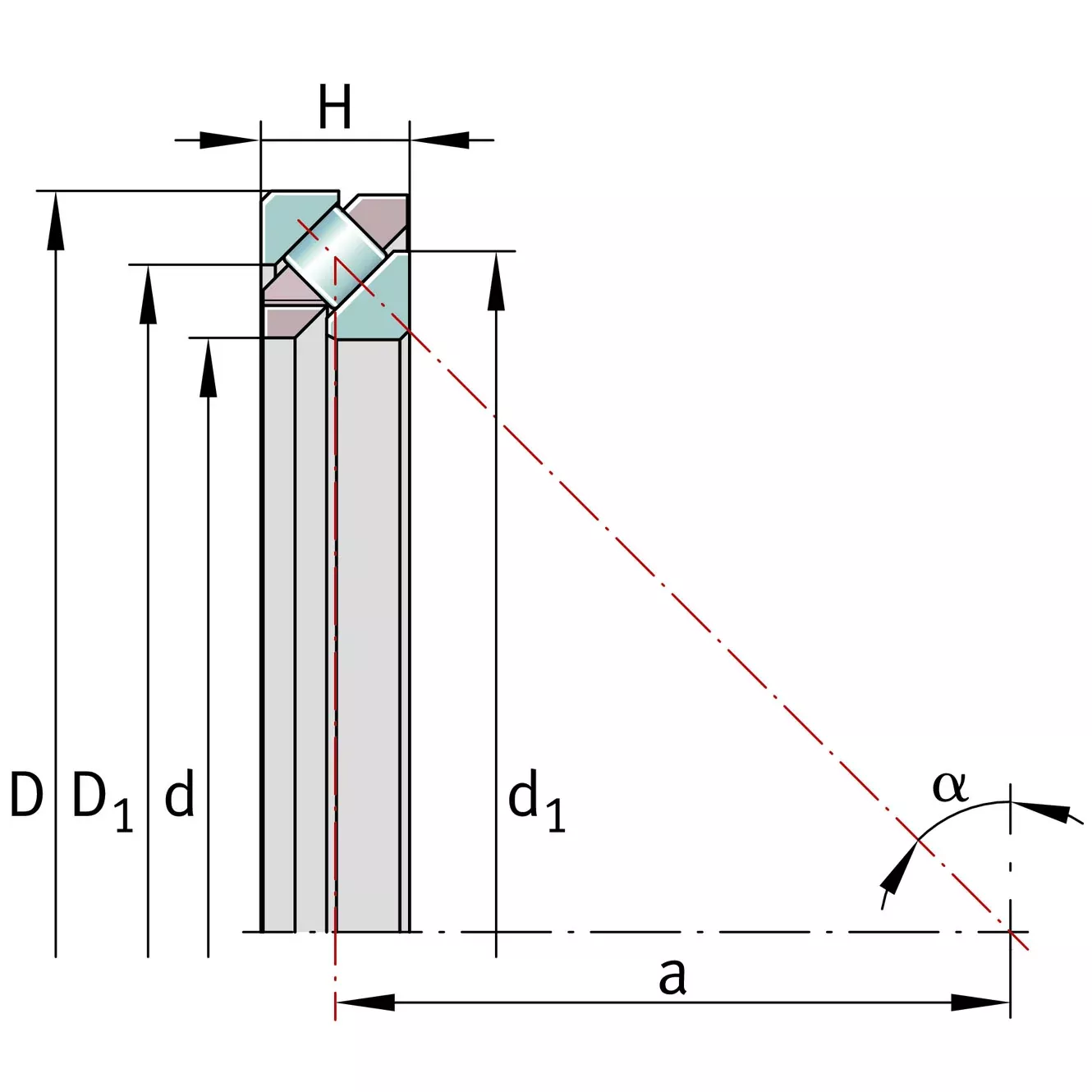
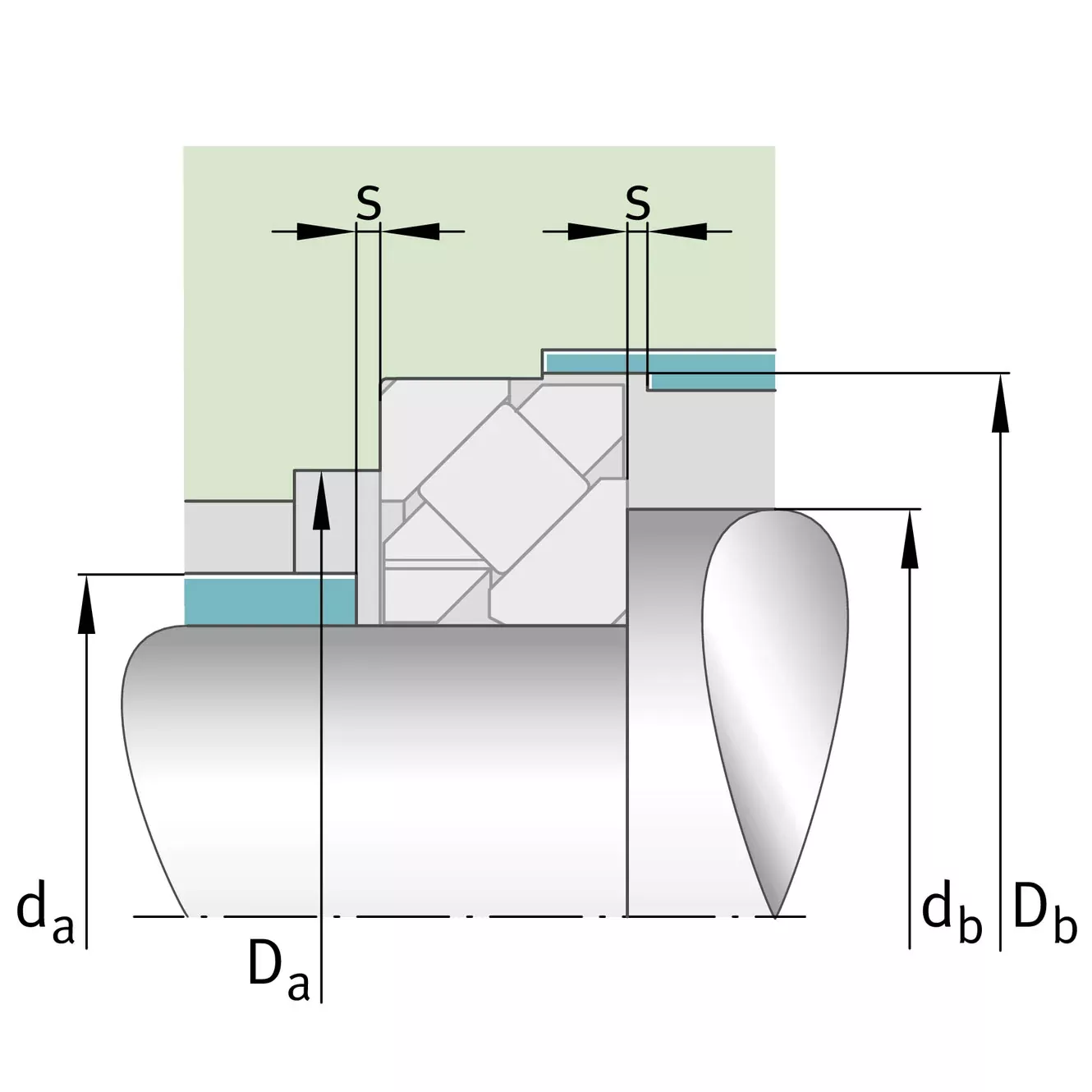
The available SGL Series covers a wide dimensional range, from compact SGL1730 to large SGL340400 configurations.
|
Designation |
Ordering Designation |
Mass (kg) |
d (mm) |
D (mm) |
H (mm) |
Cr (N) |
C0r (N) |
Ca (N) |
C0a (N) |
Reference Speed (r/min) |
Limiting Speed (r/min) |
|
SGL1730 |
F-587391.SGL |
0.015 |
17 |
30 |
7 |
3,500 |
3,550 |
8,400 |
17,700 |
7,000 |
3,200 |
|
SGL3042 |
F-587397.SGL |
0.022 |
30 |
42 |
7 |
4,400 |
5,500 |
10,600 |
27,500 |
5,100 |
2,100 |
|
SGL3547 |
F-618875.SGL |
0.024 |
35 |
47 |
7 |
4,800 |
6,400 |
11,500 |
32,000 |
4,600 |
1,800 |
|
SGL4052 |
F-557493.SGL |
0.026 |
40 |
52 |
7 |
6,900 |
9,600 |
16,600 |
48,000 |
4,300 |
1,600 |
|
SGL4558 |
F-238341.SGL |
0.033 |
45 |
58 |
7 |
7,600 |
11,200 |
18,200 |
56,000 |
3,900 |
1,400 |
|
SGL5065 |
F-557494.SGL |
0.042 |
50 |
65 |
7 |
9,900 |
14,900 |
23,700 |
75,000 |
3,600 |
1,300 |
|
SGL6078 |
F-238166.SGL |
0.085 |
60 |
78 |
10 |
14,300 |
21,700 |
34,500 |
109,000 |
3,200 |
1,100 |
|
SGL6585 |
F-557495.SGL |
0.106 |
65 |
85 |
10 |
15,000 |
23,900 |
36,000 |
119,000 |
3,000 |
1,000 |
|
SGL80100 |
F-238167.SGL |
0.120 |
80 |
100 |
10 |
16,600 |
29,000 |
40,000 |
144,000 |
2,500 |
850 |
|
SGL85110 |
F-587396.SGL |
0.228 |
85 |
110 |
13 |
21,400 |
36,000 |
51,000 |
180,000 |
2,400 |
750 |
|
SGL98130 |
F-238584.SGL |
0.420 |
98 |
130 |
16 |
37,000 |
63,000 |
89,000 |
315,000 |
2,200 |
650 |
|
SGL105130 |
F-240120.SGL |
0.269 |
105 |
130 |
13 |
28,500 |
52,000 |
68,000 |
260,000 |
2,000 |
600 |
|
SGL130165 |
F-631562.SGL |
0.640 |
130 |
165 |
17.5 |
49,000 |
90,000 |
118,000 |
450,000 |
1,800 |
500 |
|
SGL140175 |
F-550953.SGL |
0.690 |
140 |
175 |
18 |
50,000 |
95,000 |
121,000 |
475,000 |
1,700 |
450 |
|
SGL180225 |
F-550954.SGL |
1.440 |
180 |
225 |
22 |
75,000 |
151,000 |
181,000 |
750,000 |
1,500 |
350 |
|
SGL200250 |
F-565516.SGL |
1.930 |
200 |
250 |
24 |
100,000 |
199,000 |
240,000 |
990,000 |
1,300 |
300 |
|
SGL240310 |
F-571366.SGL |
4.550 |
240 |
310 |
33 |
153,000 |
320,000 |
370,000 |
1,600,000 |
1,200 |
250 |
|
SGL260320 |
F-555613.SGL |
3.000 |
260 |
320 |
30 |
126,000 |
280,000 |
305,000 |
1,390,000 |
1,100 |
250 |
|
SGL290330 |
F-614821.SGL |
1.780 |
290 |
330 |
20 |
84,000 |
217,000 |
203,000 |
1,090,000 |
1,000 |
200 |
|
SGL340400 |
F-565223.SGL |
4.850 |
340 |
400 |
30 |
181,000 |
440,000 |
435,000 |
2,200,000 |
900 |
200 |
Note: The values above are reference data for the listed bearing configurations. Actual allowable speed, load, preload, temperature, lubrication, and service life should be evaluated according to the complete bearing and machine design.
For engineers replacing an existing bearing or developing a new machine, the designation alone is not enough. The following information should be confirmed before ordering.
Determine both the continuous and peak loads acting on the bearing. Static load conditions are particularly important for indexing tables, clamping systems, and mechanisms that remain under load while stationary.
The basic dynamic and static load ratings in the table can be used as starting points for bearing selection, but they should not be interpreted as the allowable operating load without considering the complete calculation.
The SGL range includes both relatively high-speed small bearings and large-diameter bearings with lower limiting speeds.
For example, SGL1730 has a listed reference speed of 7,000 r/min and limiting speed of 3,200 r/min, while SGL340400 is listed at 900 r/min and 200 r/min respectively.
If the application involves continuous high-speed rotation, heat generation, lubrication, preload, and cage behavior should be evaluated together.
Preload has a direct influence on bearing rigidity, running torque, heat generation, and positioning behavior.
Too little preload may allow unwanted movement or reduced stiffness. Excessive preload can increase friction and operating temperature.
For precision equipment, the appropriate preload should therefore be determined from the machine's stiffness and accuracy requirements rather than selected independently from the bearing.
Even a precision bearing can perform poorly if the mounting components are not controlled.
Shaft diameter, housing bore, shoulder geometry, runout, surface finish, alignment, and mounting force all influence the final bearing condition.
For OEM applications, these installation parameters should be reviewed together with the bearing drawing.
The SGL Series can be considered for machinery where controlled axial load and positioning behavior are important, including:
· CNC machine tools
· Rotary indexing tables
· Precision positioning equipment
· Injection molding machinery
· Servo-driven heavy-load mechanisms
· Vertical grinding equipment
· Industrial automation systems
· Robotic transmission assemblies
· High-load mechanical drive systems
For machine tools and rotary tables, the bearing selection should be coordinated with the required axial rigidity, rotational accuracy, preload, and installation arrangement.
BMT has been manufacturing bearings since 2004 and has developed non-standard bearing solutions since 2005. Its production system includes automated grinding and assembly equipment, supported by dimensional and functional inspection capabilities.
For OEM customers, this experience is useful when the required bearing does not correspond directly to a standard catalog designation.
BMT can support projects involving:
· Standard and non-standard bearing requirements
· OEM bearing development
· Bearing dimension customization
· Technical parameter confirmation
· Laser marking
· Private labeling and packaging
· Batch production
· Export supply
For replacement projects, supplying the original bearing designation, drawing, application information, or operating conditions can help the engineering team confirm the appropriate configuration.
It is used in machinery where axial load capacity needs to be combined with controlled contact geometry and positioning rigidity. Typical applications include machine tools, rotary tables, precision automation, and heavy mechanical assemblies.
The main difference is the contact arrangement and its influence on load transfer and positioning behavior. The SGL Series is designed around angular contact roller geometry rather than relying on a conventional thrust-bearing contact arrangement.
The exact load capability depends on the bearing configuration and application. The supplied technical table includes radial and axial dynamic and static load ratings. For combined-load applications, the actual load ratio and operating conditions should be checked before selection.
Start with the required bore and outside diameter, then check axial and radial loads, operating speed, preload, installation space, lubrication, temperature, and required positioning accuracy. For an OEM project, a bearing drawing and operating conditions are preferable to selecting only by dimensions.
Reference speed is a guideline value for the listed bearing configuration. It should not be treated as a universal maximum operating speed. The actual permissible speed depends on lubrication, preload, load, heat dissipation, cage design, and installation conditions.
Yes. BMT has experience developing non-standard bearings and can work with OEM customers on dimensional and application-specific requirements. Drawings, original part numbers, load conditions, and operating parameters can be used for engineering evaluation.
For the fastest technical evaluation, provide the bearing designation or drawing, shaft and housing dimensions, axial and radial loads, rotational speed, operating temperature, lubrication method, installation arrangement, and required quantity.
Send us the required bearing designation, drawing, or application parameters. BMT can evaluate the dimensional and operating requirements and provide a suitable bearing configuration for your equipment.
Product Summary
BMT SGL Series Axial Angular Contact Roller Bearings are designed for machinery that needs controlled axial movement, high rigidity, and stable positioning under combined loads. The series covers bore sizes from 17 to 340 mm and provides different load ratings and speed capabilities for machine tools, rotary tables, automation equipment, and heavy-duty transmission systems. The bearing geometry, preload, raceway accuracy, lubrication, and mounting conditions should be matched to the actual operating load and speed.
Axial loading is not simply a matter of selecting a bearing with a higher load rating. In precision machinery, the bearing must also control elastic deformation, maintain contact stability, and preserve positioning accuracy throughout repeated operating cycles.
The SGL Series uses an angular contact roller arrangement to provide controlled contact between the rolling elements and raceways. This makes it suitable for applications where axial rigidity and positioning behavior are more important than the requirements of a conventional thrust bearing.
For equipment manufacturers, bearing selection should therefore consider the complete operating condition rather than bearing dimensions alone. Axial and radial loads, preload, rotational speed, temperature, lubrication, shaft and housing accuracy, and installation method all affect actual bearing performance.
The SGL design is intended for applications in which axial forces and positioning accuracy need to be controlled at the same time.
The roller contact geometry provides a defined load path between the bearing rings and rolling elements. Under axial loading, the contact arrangement helps distribute the applied force through the raceway rather than relying only on a simple thrust-contact configuration.
This is particularly relevant to:
· Precision positioning mechanisms
· Rotary indexing systems
· Machine-tool assemblies
· Heavy automation equipment
· Servo-driven mechanisms
· Industrial transmission systems
The actual stiffness and load capacity of a bearing assembly depend on the complete system design, including preload and mounting accuracy.
The available SGL Series covers a wide dimensional range, from compact SGL1730 to large SGL340400 configurations.
|
Designation |
Ordering Designation |
Mass (kg) |
d (mm) |
D (mm) |
H (mm) |
Cr (N) |
C0r (N) |
Ca (N) |
C0a (N) |
Reference Speed (r/min) |
Limiting Speed (r/min) |
|
SGL1730 |
F-587391.SGL |
0.015 |
17 |
30 |
7 |
3,500 |
3,550 |
8,400 |
17,700 |
7,000 |
3,200 |
|
SGL3042 |
F-587397.SGL |
0.022 |
30 |
42 |
7 |
4,400 |
5,500 |
10,600 |
27,500 |
5,100 |
2,100 |
|
SGL3547 |
F-618875.SGL |
0.024 |
35 |
47 |
7 |
4,800 |
6,400 |
11,500 |
32,000 |
4,600 |
1,800 |
|
SGL4052 |
F-557493.SGL |
0.026 |
40 |
52 |
7 |
6,900 |
9,600 |
16,600 |
48,000 |
4,300 |
1,600 |
|
SGL4558 |
F-238341.SGL |
0.033 |
45 |
58 |
7 |
7,600 |
11,200 |
18,200 |
56,000 |
3,900 |
1,400 |
|
SGL5065 |
F-557494.SGL |
0.042 |
50 |
65 |
7 |
9,900 |
14,900 |
23,700 |
75,000 |
3,600 |
1,300 |
|
SGL6078 |
F-238166.SGL |
0.085 |
60 |
78 |
10 |
14,300 |
21,700 |
34,500 |
109,000 |
3,200 |
1,100 |
|
SGL6585 |
F-557495.SGL |
0.106 |
65 |
85 |
10 |
15,000 |
23,900 |
36,000 |
119,000 |
3,000 |
1,000 |
|
SGL80100 |
F-238167.SGL |
0.120 |
80 |
100 |
10 |
16,600 |
29,000 |
40,000 |
144,000 |
2,500 |
850 |
|
SGL85110 |
F-587396.SGL |
0.228 |
85 |
110 |
13 |
21,400 |
36,000 |
51,000 |
180,000 |
2,400 |
750 |
|
SGL98130 |
F-238584.SGL |
0.420 |
98 |
130 |
16 |
37,000 |
63,000 |
89,000 |
315,000 |
2,200 |
650 |
|
SGL105130 |
F-240120.SGL |
0.269 |
105 |
130 |
13 |
28,500 |
52,000 |
68,000 |
260,000 |
2,000 |
600 |
|
SGL130165 |
F-631562.SGL |
0.640 |
130 |
165 |
17.5 |
49,000 |
90,000 |
118,000 |
450,000 |
1,800 |
500 |
|
SGL140175 |
F-550953.SGL |
0.690 |
140 |
175 |
18 |
50,000 |
95,000 |
121,000 |
475,000 |
1,700 |
450 |
|
SGL180225 |
F-550954.SGL |
1.440 |
180 |
225 |
22 |
75,000 |
151,000 |
181,000 |
750,000 |
1,500 |
350 |
|
SGL200250 |
F-565516.SGL |
1.930 |
200 |
250 |
24 |
100,000 |
199,000 |
240,000 |
990,000 |
1,300 |
300 |
|
SGL240310 |
F-571366.SGL |
4.550 |
240 |
310 |
33 |
153,000 |
320,000 |
370,000 |
1,600,000 |
1,200 |
250 |
|
SGL260320 |
F-555613.SGL |
3.000 |
260 |
320 |
30 |
126,000 |
280,000 |
305,000 |
1,390,000 |
1,100 |
250 |
|
SGL290330 |
F-614821.SGL |
1.780 |
290 |
330 |
20 |
84,000 |
217,000 |
203,000 |
1,090,000 |
1,000 |
200 |
|
SGL340400 |
F-565223.SGL |
4.850 |
340 |
400 |
30 |
181,000 |
440,000 |
435,000 |
2,200,000 |
900 |
200 |
Note: The values above are reference data for the listed bearing configurations. Actual allowable speed, load, preload, temperature, lubrication, and service life should be evaluated according to the complete bearing and machine design.
For engineers replacing an existing bearing or developing a new machine, the designation alone is not enough. The following information should be confirmed before ordering.
Determine both the continuous and peak loads acting on the bearing. Static load conditions are particularly important for indexing tables, clamping systems, and mechanisms that remain under load while stationary.
The basic dynamic and static load ratings in the table can be used as starting points for bearing selection, but they should not be interpreted as the allowable operating load without considering the complete calculation.
The SGL range includes both relatively high-speed small bearings and large-diameter bearings with lower limiting speeds.
For example, SGL1730 has a listed reference speed of 7,000 r/min and limiting speed of 3,200 r/min, while SGL340400 is listed at 900 r/min and 200 r/min respectively.
If the application involves continuous high-speed rotation, heat generation, lubrication, preload, and cage behavior should be evaluated together.
Preload has a direct influence on bearing rigidity, running torque, heat generation, and positioning behavior.
Too little preload may allow unwanted movement or reduced stiffness. Excessive preload can increase friction and operating temperature.
For precision equipment, the appropriate preload should therefore be determined from the machine's stiffness and accuracy requirements rather than selected independently from the bearing.
Even a precision bearing can perform poorly if the mounting components are not controlled.
Shaft diameter, housing bore, shoulder geometry, runout, surface finish, alignment, and mounting force all influence the final bearing condition.
For OEM applications, these installation parameters should be reviewed together with the bearing drawing.
Bearing performance is strongly influenced by raceway geometry and surface condition.
BMT uses automated grinding and assembly processes for bearing production, with dimensional and functional inspection incorporated into the manufacturing process. The purpose is to maintain consistency in critical parameters such as raceway geometry, dimensional accuracy, clearance, and running behavior.
For precision machinery, manufacturing consistency is particularly important because small variations in bearing geometry or preload can affect vibration, positioning repeatability, and operating temperature.
The appropriate bearing material and lubrication configuration depend on the application.
Standard bearing steel configurations are suitable for many industrial applications, while special material or surface-treatment options may be considered where the bearing is exposed to unusual humidity, contamination, temperature, or corrosion conditions.
However, material selection should be evaluated together with lubrication, sealing, load, and speed. A material change alone does not automatically make a bearing suitable for every harsh environment.
The SGL Series can be considered for machinery where controlled axial load and positioning behavior are important, including:
· CNC machine tools
· Rotary indexing tables
· Precision positioning equipment
· Injection molding machinery
· Servo-driven heavy-load mechanisms
· Vertical grinding equipment
· Industrial automation systems
· Robotic transmission assemblies
· High-load mechanical drive systems
For machine tools and rotary tables, the bearing selection should be coordinated with the required axial rigidity, rotational accuracy, preload, and installation arrangement.
BMT has been manufacturing bearings since 2004 and has developed non-standard bearing solutions since 2005. Its production system includes automated grinding and assembly equipment, supported by dimensional and functional inspection capabilities.
For OEM customers, this experience is useful when the required bearing does not correspond directly to a standard catalog designation.
BMT can support projects involving:
· Standard and non-standard bearing requirements
· OEM bearing development
· Bearing dimension customization
· Technical parameter confirmation
· Laser marking
· Private labeling and packaging
· Batch production
· Export supply
For replacement projects, supplying the original bearing designation, drawing, application information, or operating conditions can help the engineering team confirm the appropriate configuration.
It is used in machinery where axial load capacity needs to be combined with controlled contact geometry and positioning rigidity. Typical applications include machine tools, rotary tables, precision automation, and heavy mechanical assemblies.
The main difference is the contact arrangement and its influence on load transfer and positioning behavior. The SGL Series is designed around angular contact roller geometry rather than relying on a conventional thrust-bearing contact arrangement.
The exact load capability depends on the bearing configuration and application. The supplied technical table includes radial and axial dynamic and static load ratings. For combined-load applications, the actual load ratio and operating conditions should be checked before selection.
Start with the required bore and outside diameter, then check axial and radial loads, operating speed, preload, installation space, lubrication, temperature, and required positioning accuracy. For an OEM project, a bearing drawing and operating conditions are preferable to selecting only by dimensions.
Reference speed is a guideline value for the listed bearing configuration. It should not be treated as a universal maximum operating speed. The actual permissible speed depends on lubrication, preload, load, heat dissipation, cage design, and installation conditions.
Yes. BMT has experience developing non-standard bearings and can work with OEM customers on dimensional and application-specific requirements. Drawings, original part numbers, load conditions, and operating parameters can be used for engineering evaluation.
For the fastest technical evaluation, provide the bearing designation or drawing, shaft and housing dimensions, axial and radial loads, rotational speed, operating temperature, lubrication method, installation arrangement, and required quantity.
Send us the required bearing designation, drawing, or application parameters. BMT can evaluate the dimensional and operating requirements and provide a suitable bearing configuration for your equipment.
Address
No.183,Longfeng,West of Zhangting industrial Zone,Yuyao,Ningbo,China
Tel